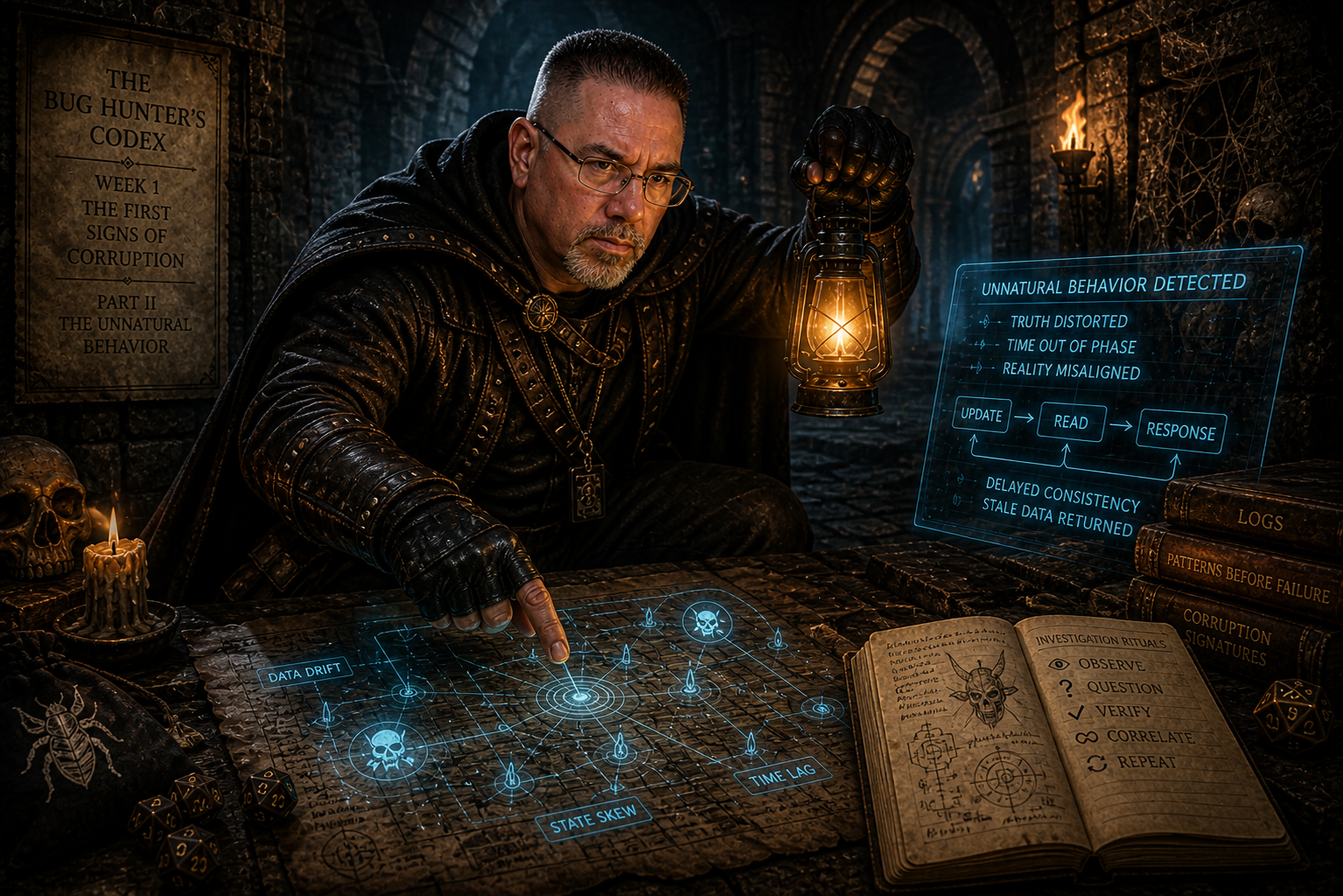
The Bug Hunter’s Codex, Part II: The Unnatural Behavior
When the world bends but does not break, you are already standing inside the problem.
Week 1 is never about the obvious monsters. It is about the subtle distortions that creep into the edges of the system before anything truly breaks. In Part I, I learned to read the omens in the logs. Here, the hunt deepens. I am not just reading signs anymore. I am stepping into the territory where the world itself begins to shift. The system still stands. It still answers. It still breathes. But something is wrong in a way that cannot be proven at a glance. This is where most hunters turn back. This is where the corruption thrives.
I have learned, as a hunter of corrupted systems, to fear the moments when nothing crashes.
Not the loud failures. Not the stack traces that scream like wounded beasts in the dark. Those are honest creatures. They leave tracks. They leave blood in the snow. They can be followed, cornered, and slain. It is the quiet ones that concern me. The ones that move without sound, leaving no trace except a feeling that something is not right.
The system responds. The interface loads. The data returns. Everything appears to function. And yet something feels wrong, like stepping into a tavern where every patron goes silent as I cross the threshold, their eyes lingering just a second too long. The fire still burns. The mugs still sit on the table. But the room has changed.
This is the unnatural behavior.
In my early days, I trusted outcomes. If the function returned data, I assumed success. If the page rendered, I moved on. That was the thinking of a novice, someone who believed the world behaved exactly as it appeared. But systems, like enchanted forests, can distort perception. They can return answers that look correct while hiding the truth just beneath the surface.
That is where the real hunt begins.
I remember a system that handled user profiles. It seemed simple, like a minor contract handed to a low-level adventurer. Fetch the user. Display the data. Allow updates. Save changes. It worked. It always worked. Until it did not, and even then it insisted that it did.
The code looked clean, almost suspiciously so, like a room that had been arranged too perfectly.
async function getUser(userId) {
  const response = await fetch(`/api/users/${userId}`);
  const data = await response.json();
  return data;
}

async function updateUser(userId, updates) {
  const response = await fetch(`/api/users/${userId}`, {
    method: 'POST',
    headers: {
      'Content-Type': 'application/json'
    },
    body: JSON.stringify(updates)
  });

  return response.json();
}
Nothing obvious. No jagged edges. No broken runes carved into the stone. Just a clean flow of data moving in and out like a well-rehearsed incantation.
But the system began to whisper.
After an update, the interface would sometimes show the old data, as if the world had failed to remember what had just happened. Not always. Not consistently. Just enough to make me question my own memory, like a trickster spirit bending reality at the edges.
That is not a failure.
That is a distortion.
So I changed how I hunted. I stopped asking whether the system worked. I started asking whether it told the truth.
I placed markers along the trail, the way a ranger marks a path through dangerous woods.
async function updateUser(userId, updates) {
  console.log('Sending updates', updates);

  const response = await fetch(`/api/users/${userId}`, {
    method: 'POST',
    headers: {
      'Content-Type': 'application/json'
    },
    body: JSON.stringify(updates)
  });

  const result = await response.json();

  console.log('Server responded with', result);

  return result;
}
The logs told a different story. The system claimed success every time, but the data it returned did not always reflect the change that had just been made. It was as if the system was looking into a mirror that lagged behind reality, reflecting a version of the world that had already passed.
A delayed truth is still a lie.
So I descended deeper, into the backend where the real creatures tend to hide.
app.post('/api/users/:id', async (req, res) => {
  const userId = req.params.id;
  const updates = req.body;

  await database.updateUser(userId, updates);

  const user = await database.getUser(userId);

  res.json(user);
});
The ritual appeared sound. Update, then retrieve. Cause followed by effect. A clean spell with no visible flaw.
But I have learned not to trust appearances.
The deeper layer revealed the nature of the creature.
async function updateUser(userId, updates) {
  await db.query('UPDATE users SET name = $1 WHERE id = $2', [
    updates.name,
    userId
  ]);
}

async function getUser(userId) {
  const result = await db.query('SELECT * FROM users WHERE id = $1', [
    userId
  ]);

  return result.rows[0];
}
The problem was not in the code itself. It was in the assumption that time behaves like a straight path. In truth, time inside a system behaves more like overlapping spell effects cast by different hands. The database connections formed a pool, each acting like an independent caster. Under certain conditions, the read occurred before the write had fully taken hold across the system.
The update was real, but not yet visible. The system returned a version of reality that had not caught up with itself.
It was not broken.
It was out of phase.
Creatures like this do not leave obvious tracks. They flicker at the edge of perception, like something moving just beyond the reach of torchlight. You think you see them, but when you turn your head, they are gone.
This is where many hunters fail. They assume the system is correct because it works most of the time. But intermittent truth is no truth at all.
So I bound the state.
app.post('/api/users/:id', async (req, res) => {
  const userId = req.params.id;
  const updates = req.body;

  await database.updateUser(userId, updates);

  await database.ensureConsistency(userId, updates.name);

  const user = await database.getUser(userId);

  res.json(user);
});
And within the deeper layer, I performed a controlled ritual, waiting for the world to align with itself.
async function ensureConsistency(userId, expectedName) {
  let attempts = 0;

  while (attempts < 5) {
    const user = await getUser(userId);

    if (user && user.name === expectedName) {
      return;
    }

    await new Promise(resolve => setTimeout(resolve, 50));
    attempts++;
  }
}
It felt like waiting for a spell to settle after casting, watching the air for ripples until the magic stabilized. Uncomfortable, but necessary.
Once I saw this pattern, I began to see it everywhere.
Validation, for example, often masquerades as a simple safeguard, like a ward etched into a doorway.
function validateUser(user) {
  if (!user.name) {
    return false;
  }

  if (user.age < 0) {
    return false;
  }

  return true;
}
Simple. Reliable. Or so it appears.
But upstream forces can alter the data before it ever reaches the gate, like a shapeshifter slipping past a guard.
const sanitizedUser = {
  name: '',
  age: 25
};

if (validateUser(sanitizedUser)) {
  saveUser(sanitizedUser);
}
Now the system accepts something it should not. No alarms. No flashing warnings. Just a quiet compromise, the kind that accumulates over time until the system no longer resembles the world it was meant to represent.
This is how corruption spreads. Not through catastrophic failure, but through small allowances that stack like unseen curses.
So I do not trust what works.
I test what should not.
I provoke the system, the way one might lure a hidden creature into the open.
async function simulateConflict() {
  const userId = 1;

  await Promise.all([
    updateUser(userId, { name: 'Alice' }),
    updateUser(userId, { name: 'Bob' })
  ]);

  const finalUser = await getUser(userId);

  console.log(finalUser);
}
Two competing updates, cast at the same time like rival spells colliding in midair. The result shifts. Sometimes Alice. Sometimes Bob. Sometimes something unpredictable.
That is not acceptable. Not in a system that claims to represent truth.
So I enforce order. I draw a circle. I bind the state so that only one change may take hold at a time.
async function updateUserSafely(userId, updates) {
  return db.transaction(async (trx) => {
    const current = await trx.query(
      'SELECT * FROM users WHERE id = $1 FOR UPDATE',
      [userId]
    );

    const updated = {
      ...current.rows[0],
      ...updates
    };

    await trx.query(
      'UPDATE users SET name = $1 WHERE id = $2',
      [updated.name, userId]
    );

    return updated;
  });
}
Now the system holds steady during transformation. No overlap. No flicker. The world aligns with itself again, at least in this corner of the map.
But the truth remains.
You do not eliminate unnatural behavior.
You learn to recognize it.
Week 1 is about seeing the signs before the corruption becomes visible to everyone else. The unnatural behavior is one of the earliest and most dangerous signs. A system that almost works is far more dangerous than one that fails outright. Failure draws attention. Deception thrives in silence.
So I listen differently now.
I watch for hesitation. I watch for the moment where the system responds correctly but feels wrong, like a spell that completes but leaves a bitter taste in the air. I follow that feeling, because it has never led me astray.
That instinct is not guesswork.
It is experience.
And experience, in this line of work, is earned in places where the world bends just enough to reveal what does not belong.
That is where I stand now. Not outside the system, reacting to what breaks. Not above it, pretending control. But inside it, moving with it, watching for the subtle distortions that reveal where the corruption has taken root.
The world does not have to break for the problem to exist.
Sometimes it only needs to bend.
And when it does, even slightly, I know the hunt has already begun.

Frank Jamison
Frank Jamison is a web developer and educator who writes about the intersection of structure, systems, and growth. With a background in mathematics, technical support, and software development, he approaches modern web architecture with discipline, analytical depth, and long term thinking. Frank served on active duty in the United States Army and continued his service with the California National Guard, the California Air National Guard, and the United States Air Force Reserve. His military career included honorable service recognized with the National Defense Service Medal. Those years shaped his commitment to mission focused execution, accountability, and calm problem solving under pressure. Through projects, technical writing, and long form series such as The CSS Codex, Frank explores how foundational principles shape scalable, maintainable systems. He treats front end development as an engineered discipline grounded in rules, patterns, and clarity rather than guesswork. A longtime STEM volunteer and mentor, he values precision, continuous learning, and practical application. Whether refining layouts, optimizing performance, or building portfolio tools, Frank approaches each challenge with the same mindset that guided his years in uniform: understand the system, respect the structure, and execute with purpose.

You May Also Like

The Full-Stack Campaign, Part IX: The Data Vault – Storing and Shaping Information