-
The Bug Hunter’s Codex, Part X: The Killing Blow
Strike at the source. Anything less is mercy, and mercy has consequences. There is a point in every hunt when the lantern is no longer enough. You have followed the tracks, read the claw marks, listened to the villagers describe the shape moving beyond the tree line, and mapped the dungeon room by room until the pattern finally reveals itself. At that moment, the hunter must stop circling the beast and decide where to strike. Debugging reaches that same point when investigation turns into correction, and the difference between a clean kill and a wounded monster is whether you understand the source deeply enough to end it. This week’s theme…
-
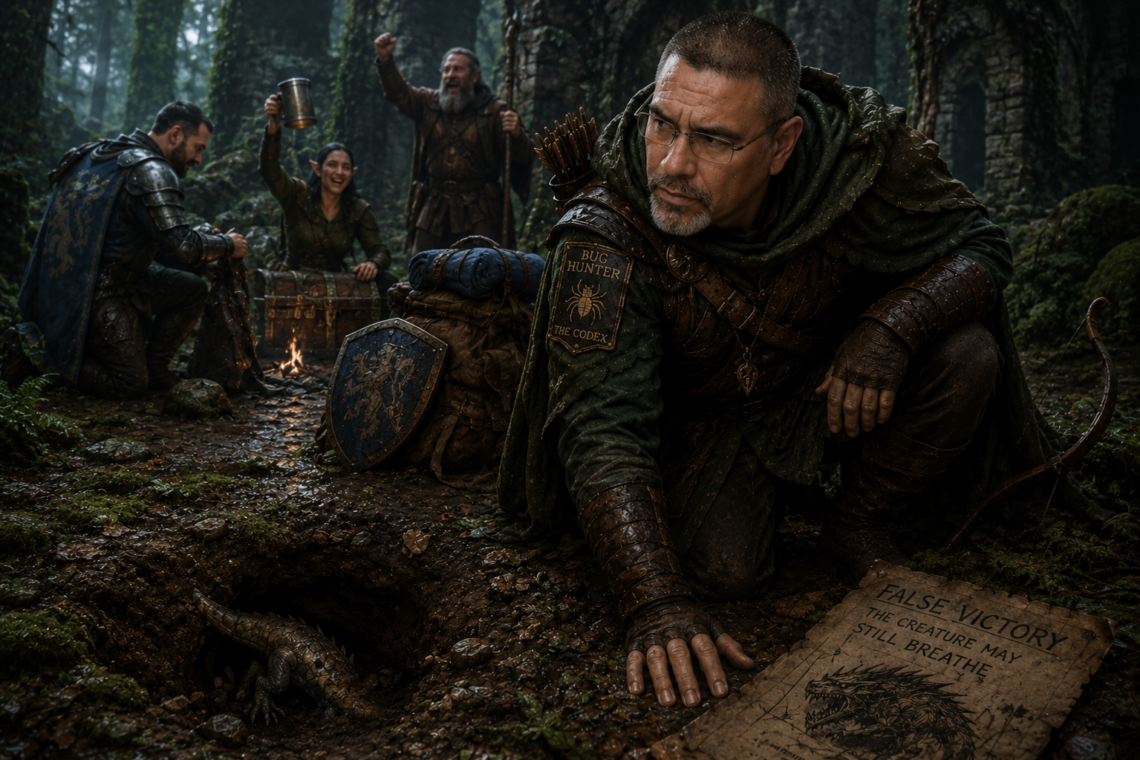
The Bug Hunter’s Codex, Part IX: The False Victory
The silence after the battle is not always peace. Sometimes, the creature still breathes. There is a lesson I wish someone had taught me much earlier in my career, because it would have saved me countless hours of frustration, embarrassment, and self inflicted suffering. Most bug hunters enter the field believing the hardest part of debugging lies in finding the creature. We imagine the struggle begins when alerts scream, users complain, and systems begin behaving like cursed ruins abandoned by wiser travelers. Yet over time, I discovered the true danger often begins after the apparent victory, when exhaustion convinces us to stop asking questions and relief disguises itself as certainty.…
-
The Bug Hunter’s Codex, Part VI: The Heisenbug
The unseen creature – vanishing under scrutiny, leaving only doubt and frustration in its wake. There comes a point in every hunter’s life when skill alone no longer feels sufficient. You have learned to read omens in logs, recognize unnatural behavior, trust your instincts, reproduce the beast, and bind the conditions that summon corruption into the world. Your confidence grows with every victory until, eventually, you encounter something that refuses to obey the rules. That creature waits in silence, hidden in the spaces between certainty and confusion, mocking every lesson that once served you well. I speak of the Heisenbug. If you have never encountered one, then your time has…
-
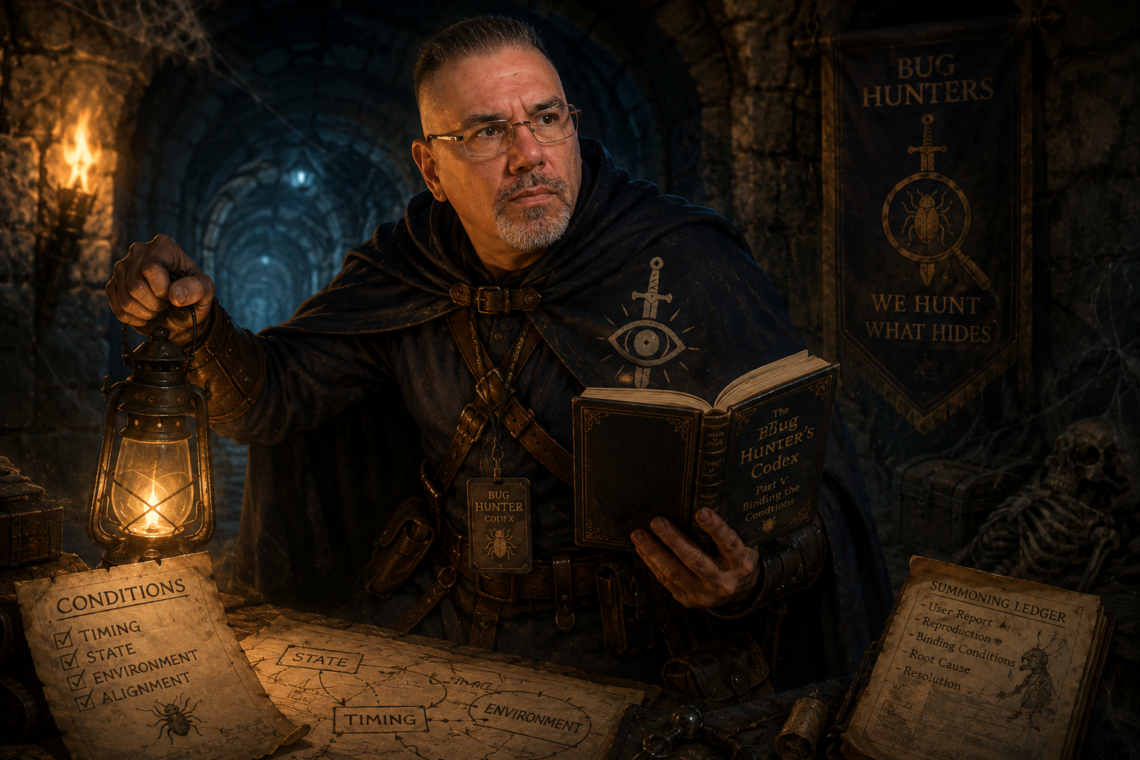
The Bug Hunter’s Codex, Part V: Binding the Conditions
Bugs are not born in isolation. They emerge when timing, state, and environment align. When an apprentice first joins me at the campfire after a long day of hunting, there is always a moment when confidence outruns wisdom. I see it in the way they speak about broken systems, as though every bug waits patiently in a single line of code, eager to confess its crimes under the slightest scrutiny. They imagine software failures as lone goblins wandering too close to civilization, isolated threats easily dispatched by a sharp eye and a sharper keyboard. Experience has taught me otherwise. The creatures worth fearing are rarely solitary, and the bugs that…
-
The Bug Hunter’s Codex, Part IV: The Ritual of Reproduction
No creature can be slain if it cannot be summoned. Control the conditions, or remain in the dark. When young developers first begin hunting bugs, they often believe the battle begins at the moment something breaks. A button fails, a form behaves strangely, an API returns nonsense, and immediately they reach for their weapons. They open files at random, scatter console logs across the codebase like breadcrumbs tossed into a storm, and begin changing conditions in hopes that luck will reveal the answer. I understand the instinct. When a creature has already wounded the village, urgency feels noble. Yet experience has taught me something far less dramatic and infinitely more…
-
The Bug Hunter’s Codex, Part III: The Hunter’s Instinct
Before proof comes suspicion. Before evidence, a feeling that something does not belong. I do not begin this lesson with tools or commands. I begin with a feeling. You have already learned to read the omens in the logs and to recognize when a system behaves in ways that defy expectation without collapsing outright. Those were your first steps into the wild. Now you stand at the edge of something deeper, where the evidence does not announce itself and the danger does not reveal its shape. This is where instinct becomes your most reliable weapon. In every campaign there is a hunter who senses the ambush before the arrow is…
-
The Bug Hunter’s Codex, Part II: The Unnatural Behavior
When the world bends but does not break, you are already standing inside the problem. Week 1 is never about the obvious monsters. It is about the subtle distortions that creep into the edges of the system before anything truly breaks. In Part I, I learned to read the omens in the logs. Here, the hunt deepens. I am not just reading signs anymore. I am stepping into the territory where the world itself begins to shift. The system still stands. It still answers. It still breathes. But something is wrong in a way that cannot be proven at a glance. This is where most hunters turn back. This is…
-
The Full-Stack Campaign, Part XII: The Final Boss – Debugging, Maintenance, and Mastery
The battlefield is quiet now. The UI stands. The server answers. The database holds its secrets without complaint. For a brief moment, it feels like the campaign is over, like the quest log has been cleared and the credits should roll. That feeling is a lie, and it is one that catches a lot of developers off guard right when they think they have finally won. The final boss is never the build. It is what comes after. It is the bug that appears only under pressure, the feature that breaks when touched, and the system that slowly drifts away from its original design until no one remembers how it…