-
The Full-Stack Campaign, Part XII: The Final Boss – Debugging, Maintenance, and Mastery
The battlefield is quiet now. The UI stands. The server answers. The database holds its secrets without complaint. For a brief moment, it feels like the campaign is over, like the quest log has been cleared and the credits should roll. That feeling is a lie, and it is one that catches a lot of developers off guard right when they think they have finally won. The final boss is never the build. It is what comes after. It is the bug that appears only under pressure, the feature that breaks when touched, and the system that slowly drifts away from its original design until no one remembers how it…
-
The Full-Stack Campaign, Part VI: The Cost of Power – From DOM Manipulation to Design
There is a moment in every developer’s journey where power reveals itself not as a gift, but as a temptation. It usually starts small. A button that needs to change color. A form that should validate before submission. A list that grows and shrinks with user input. At first, the tools feel like magic. You reach into the Document Object Model and bend it to your will. Elements appear, disappear, mutate. The page becomes alive beneath your fingertips. And then, quietly, almost politely, chaos walks in and sits down. I remember the first time I realized I had crossed that line. The code worked. Everything worked. But I could no…
-
The Full-Stack Campaign, Part IV: The First Spell – JavaScript and the Flow of Execution
There is a moment in every campaign when the world stops being something you observe and starts becoming something you influence. Up to this point, I had been shaping structure and appearance. The terrain existed. The armor was in place. The realm looked complete, but it did not yet respond. It waited. JavaScript is where that waiting ends. When I first stepped into this part of the stack, I realized something subtle but important. The browser is not just rendering a page. It is executing a sequence of instructions. It reads, evaluates, and moves forward through time. That sense of progression, of one thing happening after another, is the foundation…
-
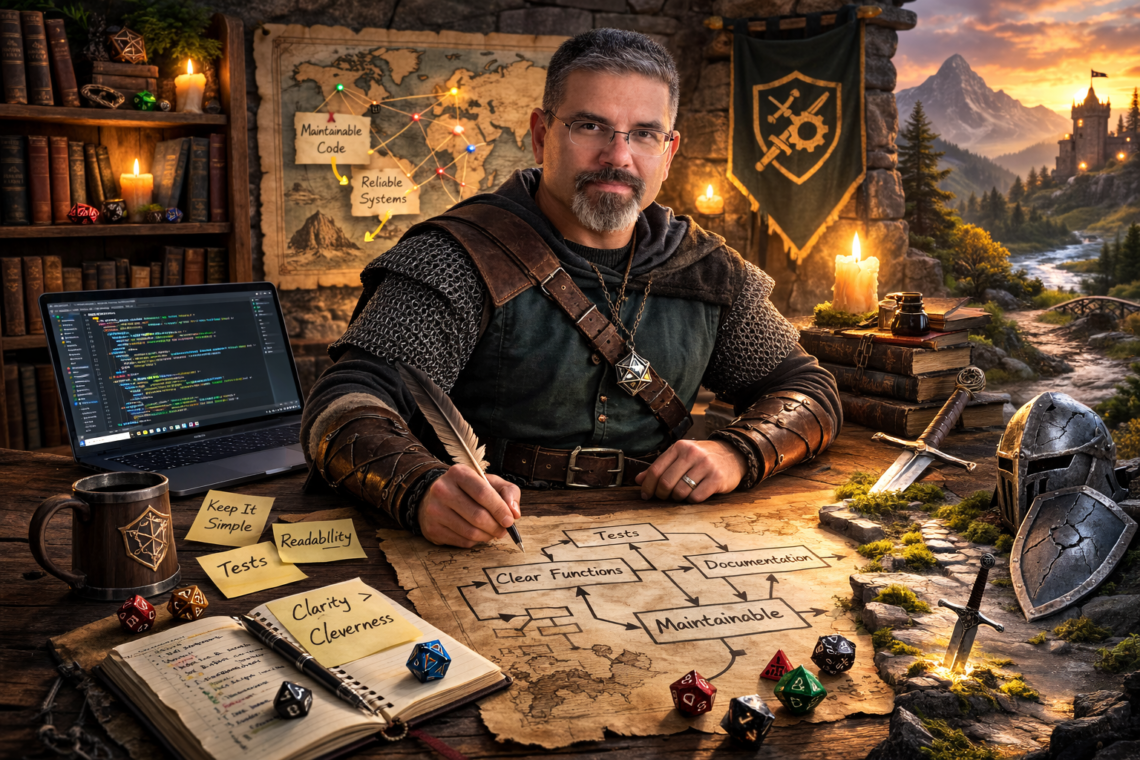
The Case for the Reliable Fighter: Why Boring Code Is Underrated
If you have ever played a long running Dungeons and Dragons campaign, you know that the party rarely falls apart because the fighter showed up in plain armor and swung a dependable sword. The chaos usually starts when someone insists on building a wild multiclass sorcerer bard warlock experiment that only works under a full moon during initiative order. I have learned that software development works the same way. The code that saves projects is rarely flashy. It is steady, readable, predictable. It is, in the best possible way, boring. Early in my development journey, I chased cleverness. I wanted elegant one liners, intricate abstractions, and patterns that made other…
-
Explaining Code: Lessons from Teaching
When I started teaching, I thought my job was to know the material. Know it cold. Know it forward and backward. Be ready for every question. What I learned instead is that knowing something and explaining something are two very different skills. That realization followed me back into software development. In the classroom, I could solve a problem in my head in seconds. But when I tried to explain it the same way I solved it – jumping steps, skipping assumptions, compressing logic – I would lose half the room. The students weren’t confused because the material was impossible. They were confused because I had teleported from A to D…