-
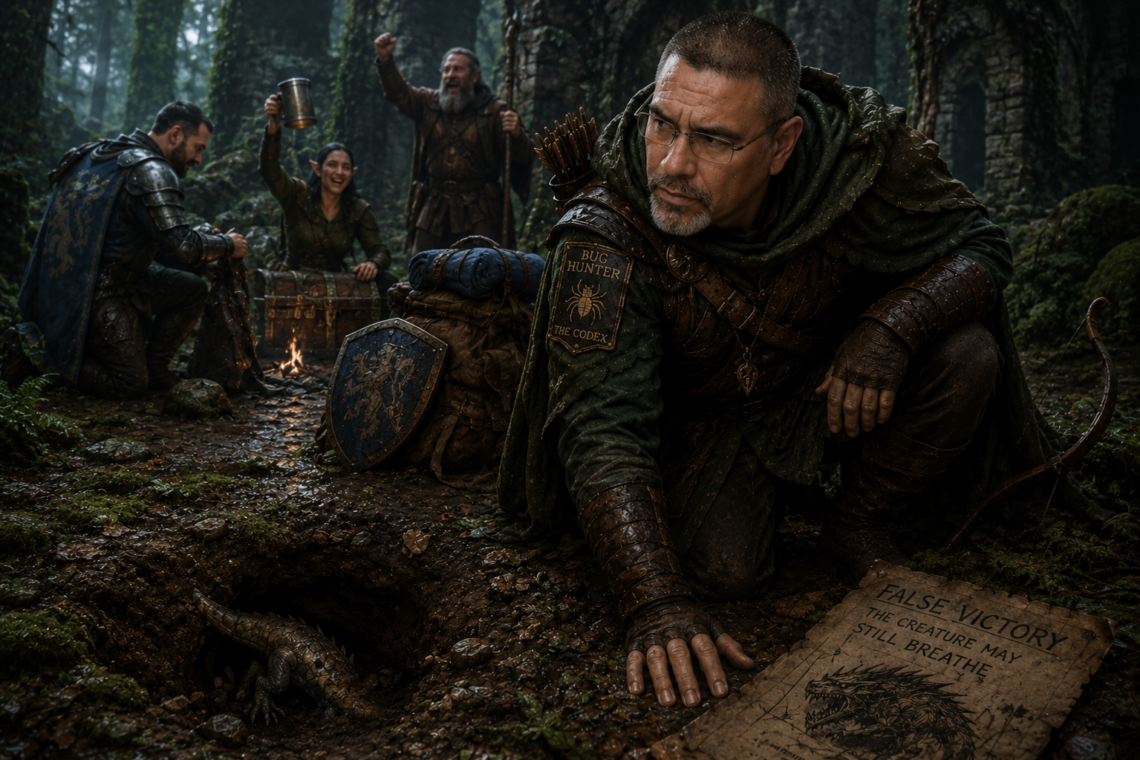
The Bug Hunter’s Codex, Part X: The Killing Blow
Strike at the source. Anything less is mercy, and mercy has consequences. There is a point in every hunt when the lantern is no longer enough. You have followed the tracks, read the claw marks, listened to the villagers describe the shape moving beyond the tree line, and mapped the dungeon room by room until the pattern finally reveals itself. At that moment, the hunter must stop circling the beast and decide where to strike. Debugging reaches that same point when investigation turns into correction, and the difference between a clean kill and a wounded monster is whether you understand the source deeply enough to end it. This week’s theme…
-
The Bug Hunter’s Codex, Part IX: The False Victory
The silence after the battle is not always peace. Sometimes, the creature still breathes. There is a lesson I wish someone had taught me much earlier in my career, because it would have saved me countless hours of frustration, embarrassment, and self inflicted suffering. Most bug hunters enter the field believing the hardest part of debugging lies in finding the creature. We imagine the struggle begins when alerts scream, users complain, and systems begin behaving like cursed ruins abandoned by wiser travelers. Yet over time, I discovered the true danger often begins after the apparent victory, when exhaustion convinces us to stop asking questions and relief disguises itself as certainty.…
-
The Full-Stack Campaign, Part XII: The Final Boss – Debugging, Maintenance, and Mastery
The battlefield is quiet now. The UI stands. The server answers. The database holds its secrets without complaint. For a brief moment, it feels like the campaign is over, like the quest log has been cleared and the credits should roll. That feeling is a lie, and it is one that catches a lot of developers off guard right when they think they have finally won. The final boss is never the build. It is what comes after. It is the bug that appears only under pressure, the feature that breaks when touched, and the system that slowly drifts away from its original design until no one remembers how it…
-
The Full-Stack Campaign, Part X: Bridging the Realms – Connecting Front End and Back End
There is a moment in every build where the illusion collapses. The interface looks complete. The layout holds. The buttons respond. Yet beneath the surface, nothing truly lives. I have stood in that moment before, staring at a polished shell that could not speak to anything beyond itself. It felt like building a castle with no roads leading in or out. Beautiful, isolated, and ultimately useless. That was when I understood that the true craft of full stack development begins at the boundary. Not in the front end alone, and not in the back end alone, but in the space where they meet and learn to speak. The front end…
-
The Full-Stack Campaign, Part VIII: Contracts of the Realm – APIs That Speak Clearly
There is a moment in every campaign when the world stops feeling local. The edges of the map blur, and what lies beyond begins to matter more than what sits directly in front of you. That is where I found myself when I began to understand APIs as something more than endpoints. They are contracts. They are promises carved into the fabric of a system, binding one part of the realm to another with clarity or with chaos. Earlier in this journey, I built what I could see. I shaped structure, controlled layout, and guided behavior. Then I stepped behind the curtain into the server, where requests became intent and…
-
The Full-Stack Campaign, Part V: The Inventory System – Managing State Without Losing Control
Every adventurer learns the same lesson eventually. It is not the sword that fails you. It is not the spellbook that betrays you. It is the moment you reach into your pack and realize you have no idea what is actually inside. That quiet panic is what state management feels like in an application that has grown beyond a simple page. Early on, everything is within reach. A variable here, a function there. The system feels small, predictable, almost polite. Then features arrive. Interactions multiply. Data begins to move. Suddenly the pack is full, and nothing is where it should be. State is the inventory of your application. It is…