-
The Bug Hunter’s Codex, Part III: The Hunter’s Instinct
Before proof comes suspicion. Before evidence, a feeling that something does not belong. I do not begin this lesson with tools or commands. I begin with a feeling. You have already learned to read the omens in the logs and to recognize when a system behaves in ways that defy expectation without collapsing outright. Those were your first steps into the wild. Now you stand at the edge of something deeper, where the evidence does not announce itself and the danger does not reveal its shape. This is where instinct becomes your most reliable weapon. In every campaign there is a hunter who senses the ambush before the arrow is…
-
The Full-Stack Campaign, Part XII: The Final Boss – Debugging, Maintenance, and Mastery
The battlefield is quiet now. The UI stands. The server answers. The database holds its secrets without complaint. For a brief moment, it feels like the campaign is over, like the quest log has been cleared and the credits should roll. That feeling is a lie, and it is one that catches a lot of developers off guard right when they think they have finally won. The final boss is never the build. It is what comes after. It is the bug that appears only under pressure, the feature that breaks when touched, and the system that slowly drifts away from its original design until no one remembers how it…
-
The CSS Codex, Part IX: Patience Is a Scaling Stat
There is a moment in every campaign where you realize you have been investing your points wrong. Early on, I poured everything into speed. Quick fixes. Rapid deployments. I treated every layout like a combat encounter that needed to be resolved immediately. Something broke, I reacted. Something misaligned, I forced it back into place. It felt like progress. It felt like momentum. It was not mastery. It was panic with better syntax. In those early levels, CSS feels like wild magic. You cast a spell and hope the outcome resembles your intent. Sometimes it works. Sometimes it explodes in a way that technically solves the problem but leaves the surrounding…
-
The Case for the Reliable Fighter: Why Boring Code Is Underrated
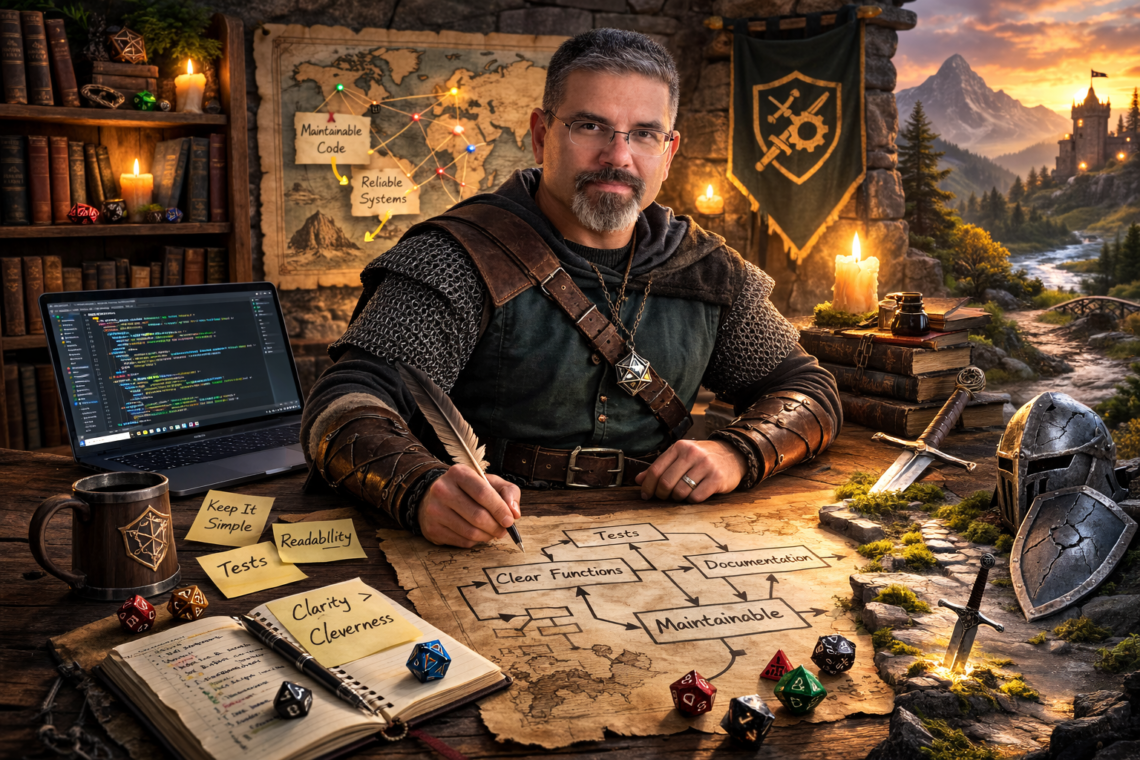
If you have ever played a long running Dungeons and Dragons campaign, you know that the party rarely falls apart because the fighter showed up in plain armor and swung a dependable sword. The chaos usually starts when someone insists on building a wild multiclass sorcerer bard warlock experiment that only works under a full moon during initiative order. I have learned that software development works the same way. The code that saves projects is rarely flashy. It is steady, readable, predictable. It is, in the best possible way, boring. Early in my development journey, I chased cleverness. I wanted elegant one liners, intricate abstractions, and patterns that made other…
-
When “It Works” Isn’t Enough
I used to think that if my JavaScript ran without errors, I had done my job. If the feature shipped, the console stayed quiet, and the tests passed, I’d mentally roll for loot and move on. Victory secured. XP gained. On to the next quest. But somewhere between shipping features and revisiting old projects, I started noticing something uncomfortable: working code is not the same thing as readable code. And readable code is the difference between a clean campaign journal and a pile of crumpled notes written during combat. One of the first times this hit me was with a small function that filtered active users and displayed their names…
-
The Long Rest I Needed: Why I Stopped Chasing “Advanced” Topics
For a long time, I treated learning like an endless dungeon crawl. No rests. No pauses. Just door after door, room after room, always pushing forward. If something was labeled advanced, I assumed that’s where I should be heading next. Anything else felt like backtracking – or worse, like I was wasting time. So I skipped ahead. Advanced JavaScript. Advanced frameworks. Advanced patterns. If the topic sounded difficult, prestigious, or slightly intimidating, I convinced myself it was necessary. That’s where real developers lived, right? High-level characters throwing fireballs while I pretended I wasn’t still squinting at the rules. I wasn’t learning badly. I was learning exhausted. And like any party…