-
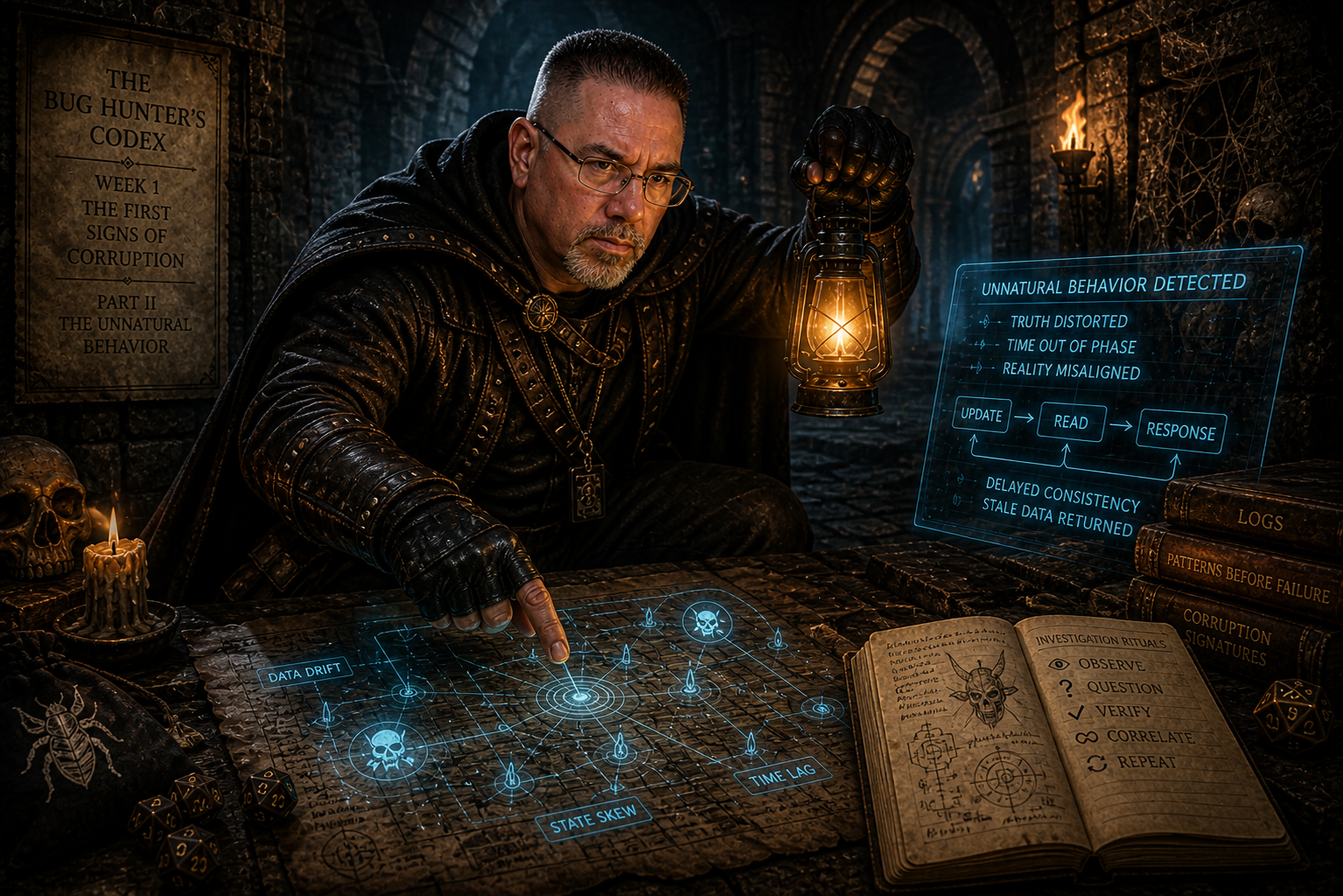
The Bug Hunter’s Codex, Part II: The Unnatural Behavior
When the world bends but does not break, you are already standing inside the problem. Week 1 is never about the obvious monsters. It is about the subtle distortions that creep into the edges of the system before anything truly breaks. In Part I, I learned to read the omens in the logs. Here, the hunt deepens. I am not just reading signs anymore. I am stepping into the territory where the world itself begins to shift. The system still stands. It still answers. It still breathes. But something is wrong in a way that cannot be proven at a glance. This is where most hunters turn back. This is…
-
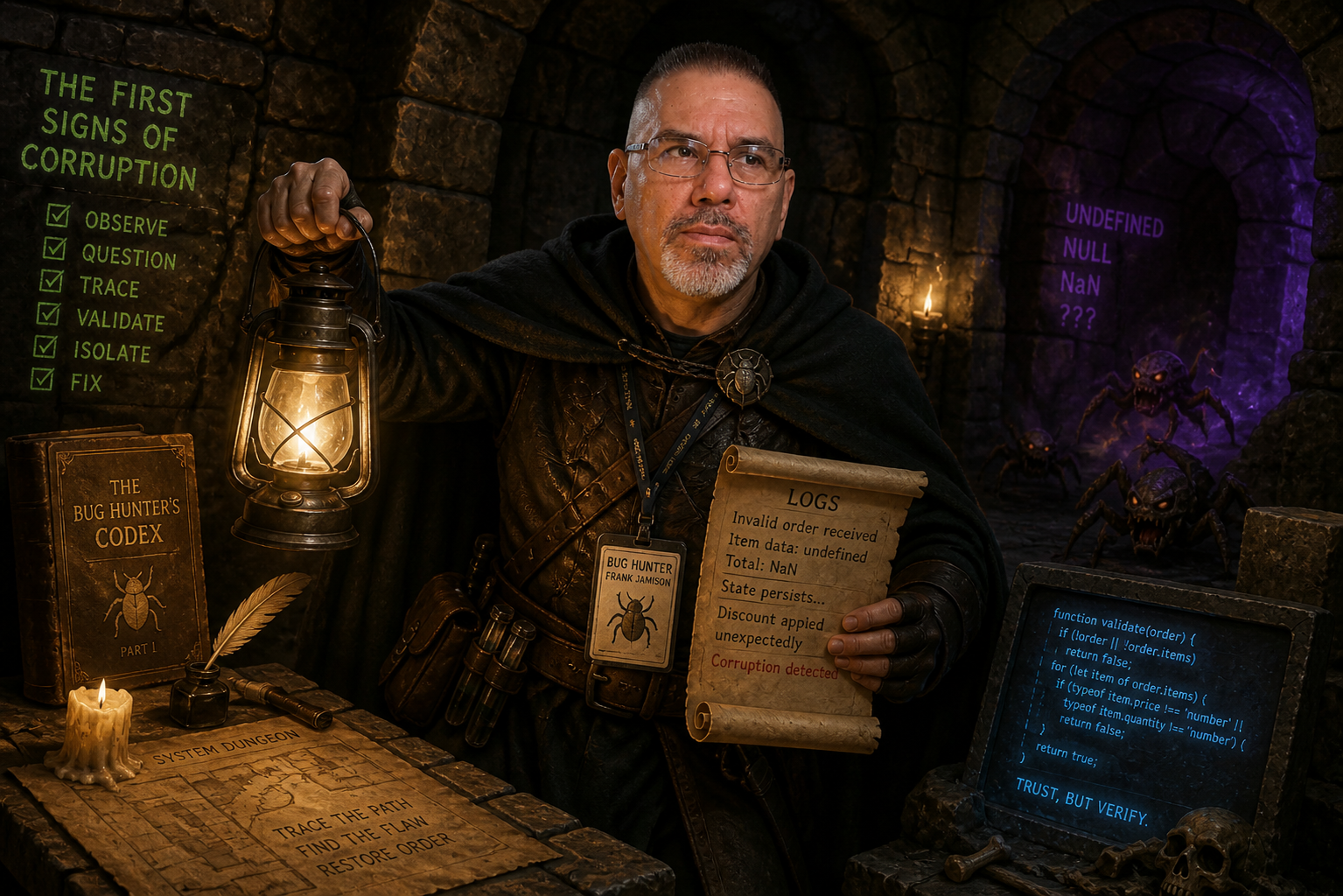
The Bug Hunter’s Codex, Part I: The Omen in the Logs
This is where the Codex begins. Not with weapons drawn or monsters revealed, but with awareness sharpened to a dangerous edge. The Bug Hunter’s Codex is a record of patterns, instincts, and hard-earned lessons from systems that refused to behave. Each part traces a different stage of the hunt, from the first uneasy suspicion to the final confrontation. Week 1 is called The First Signs of Corruption, and it focuses on the earliest warnings a system gives before anything visibly breaks. This is the stage where most people look away. This is where a hunter learns to look closer. I did not become a hunter in a single moment. There…
-
The Full-Stack Campaign, Part XII: The Final Boss – Debugging, Maintenance, and Mastery
The battlefield is quiet now. The UI stands. The server answers. The database holds its secrets without complaint. For a brief moment, it feels like the campaign is over, like the quest log has been cleared and the credits should roll. That feeling is a lie, and it is one that catches a lot of developers off guard right when they think they have finally won. The final boss is never the build. It is what comes after. It is the bug that appears only under pressure, the feature that breaks when touched, and the system that slowly drifts away from its original design until no one remembers how it…
-
The Full-Stack Campaign, Part VI: The Cost of Power – From DOM Manipulation to Design
There is a moment in every developer’s journey where power reveals itself not as a gift, but as a temptation. It usually starts small. A button that needs to change color. A form that should validate before submission. A list that grows and shrinks with user input. At first, the tools feel like magic. You reach into the Document Object Model and bend it to your will. Elements appear, disappear, mutate. The page becomes alive beneath your fingertips. And then, quietly, almost politely, chaos walks in and sits down. I remember the first time I realized I had crossed that line. The code worked. Everything worked. But I could no…
-
The Full-Stack Campaign, Part I: The First Map – How the Browser Shapes the World
Every campaign begins with a map. Not a perfect one or a complete one, but something reliable enough to take the first step without walking straight off a cliff. That is exactly how I learned to approach the browser, not as a mystery box, but as terrain that can be studied, understood, and navigated with intent. When I first started learning web development, I believed the map was the code itself. HTML, CSS, and JavaScript felt like the ground beneath my feet. If I could write them well, I assumed the world would simply appear the way I imagined it. It took some frustrating and very humbling moments to realize…
-
The Rogue Who Could Not Tab: Fixing Keyboard Navigation
I have shipped features that looked beautiful and worked perfectly with a mouse, only to discover later that they were nearly impossible to use with a keyboard. It felt like building a grand stone keep with polished banners and glowing torches, then realizing I forgot to add doors. Users could admire it from afar, but they could not enter. Fixing keyboard navigation after the fact is humbling. It forces me to examine every assumption I made about interaction. It also reminds me that accessibility is not an optional side quest. It is part of the main campaign. When I return to an existing codebase to repair keyboard support, I approach…