Web Development Fundamentals
-
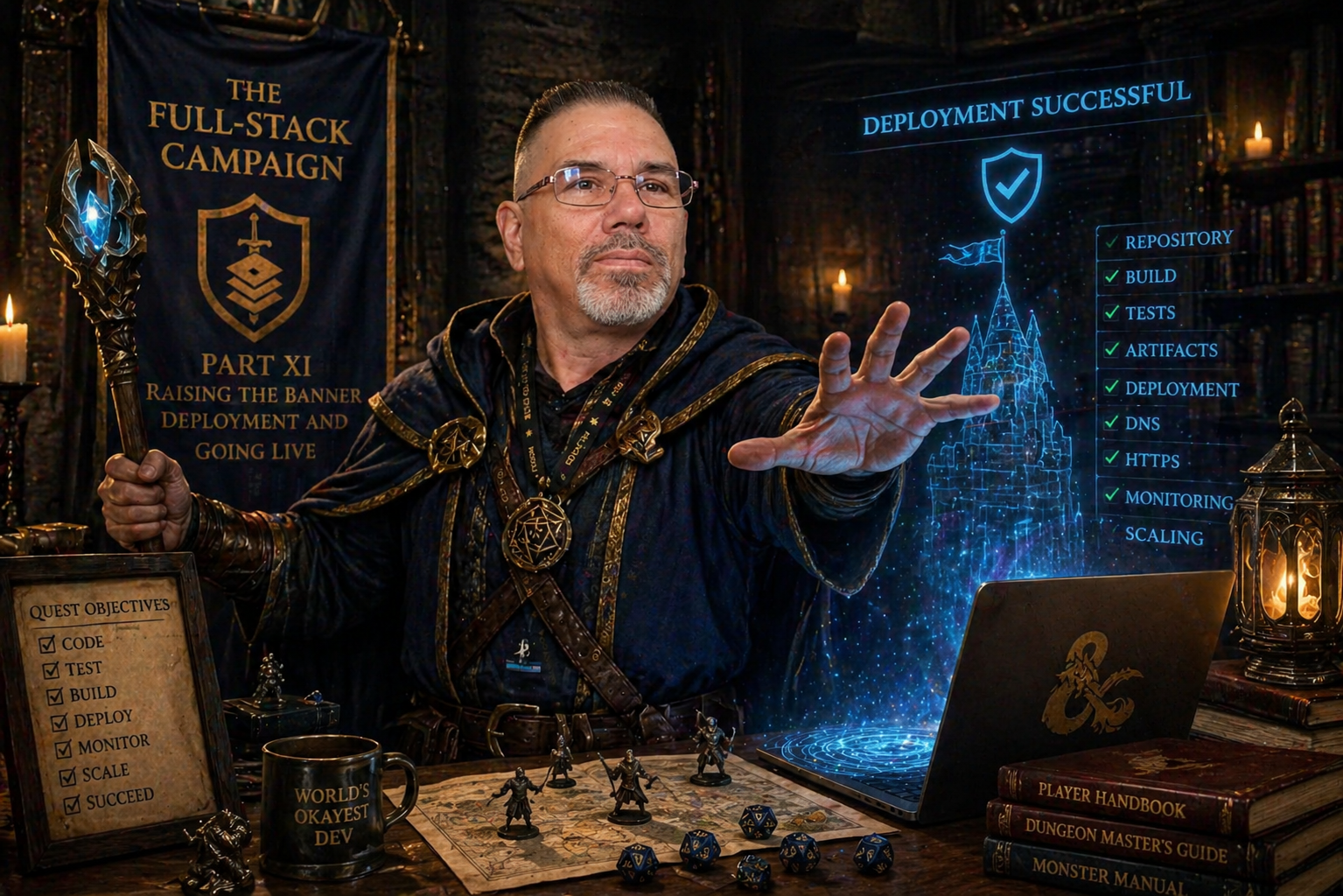
The Full-Stack Campaign, Part XI: Raising the Banner – Deployment and Going Live
There is a moment in every campaign when preparation ends and reality begins. The maps are drawn. The gear is packed. The party stands at the edge of something vast and uncertain. In development, that moment is deployment. It is the instant when carefully crafted code leaves the safety of a local environment and steps into the open world where users, traffic, and unpredictability wait like a restless horizon. I remember the first time I pushed an application live. It felt less like a technical task and more like raising a banner over a fortress I had built stone by stone. Every function, every component, every quiet decision suddenly mattered…
-
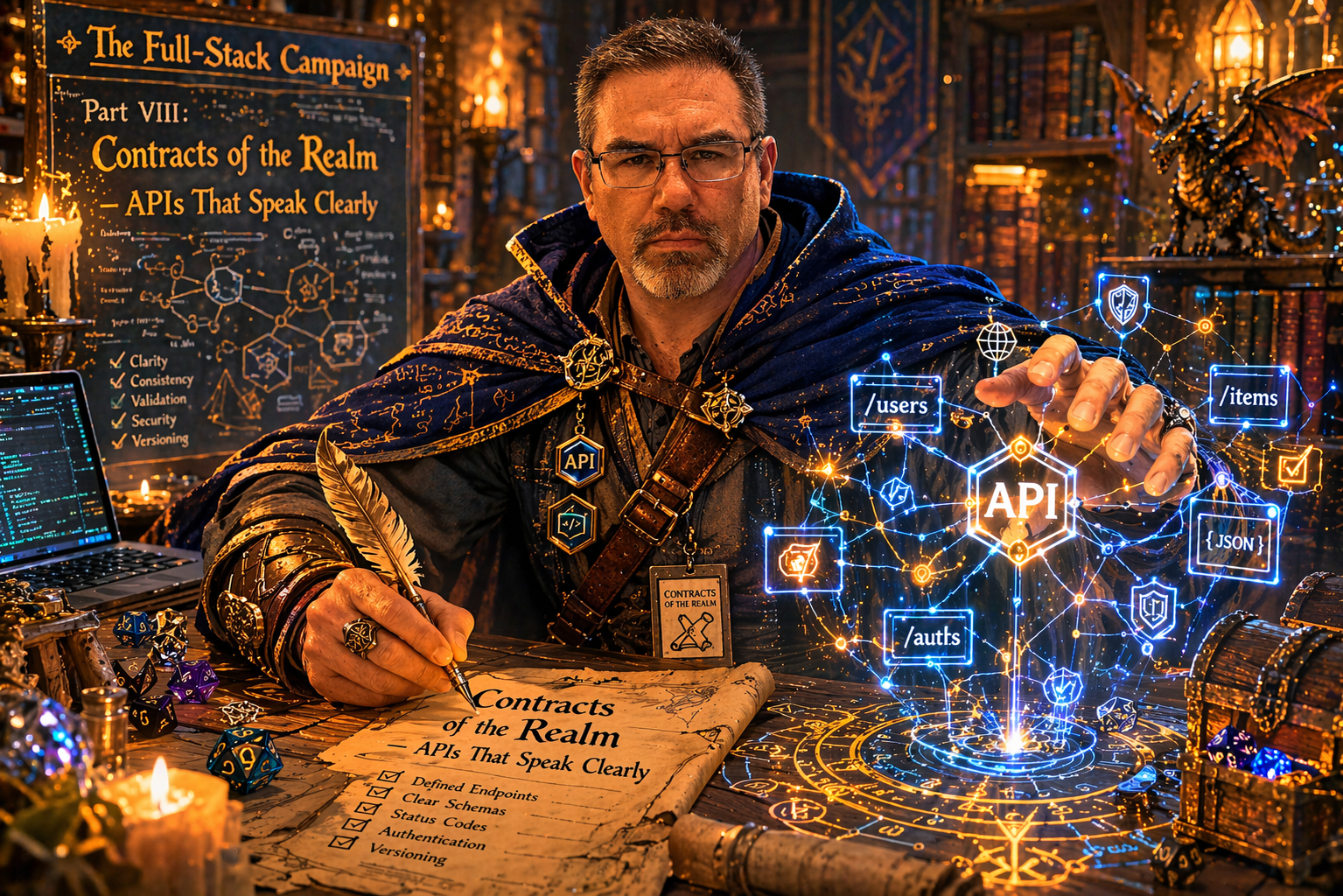
The Full-Stack Campaign, Part VIII: Contracts of the Realm – APIs That Speak Clearly
There is a moment in every campaign when the world stops feeling local. The edges of the map blur, and what lies beyond begins to matter more than what sits directly in front of you. That is where I found myself when I began to understand APIs as something more than endpoints. They are contracts. They are promises carved into the fabric of a system, binding one part of the realm to another with clarity or with chaos. Earlier in this journey, I built what I could see. I shaped structure, controlled layout, and guided behavior. Then I stepped behind the curtain into the server, where requests became intent and…
-
The Full-Stack Campaign, Part VII: The Gate Beyond the UI – What a Server Actually Does
I used to think the browser was the whole world. It felt complete, responsive, almost alive. I would shape the interface, refine the interactions, and watch everything unfold in real time. Then I reached the edge. There was a gate there, quiet and patient, waiting for me to ask a better question. What happens when the browser needs something it cannot create on its own? That is where the server lives. Not as a distant machine humming in the dark, but as a deliberate system that listens, decides, and responds. It is less theatrical than the UI, but far more powerful. If the browser is the adventurer, the server is…
-
The Full-Stack Campaign, Part VI: The Cost of Power – From DOM Manipulation to Design
There is a moment in every developer’s journey where power reveals itself not as a gift, but as a temptation. It usually starts small. A button that needs to change color. A form that should validate before submission. A list that grows and shrinks with user input. At first, the tools feel like magic. You reach into the Document Object Model and bend it to your will. Elements appear, disappear, mutate. The page becomes alive beneath your fingertips. And then, quietly, almost politely, chaos walks in and sits down. I remember the first time I realized I had crossed that line. The code worked. Everything worked. But I could no…
-
The Full-Stack Campaign, Part V: The Inventory System – Managing State Without Losing Control
Every adventurer learns the same lesson eventually. It is not the sword that fails you. It is not the spellbook that betrays you. It is the moment you reach into your pack and realize you have no idea what is actually inside. That quiet panic is what state management feels like in an application that has grown beyond a simple page. Early on, everything is within reach. A variable here, a function there. The system feels small, predictable, almost polite. Then features arrive. Interactions multiply. Data begins to move. Suddenly the pack is full, and nothing is where it should be. State is the inventory of your application. It is…
-
The Full-Stack Campaign, Part IV: The First Spell – JavaScript and the Flow of Execution
There is a moment in every campaign when the world stops being something you observe and starts becoming something you influence. Up to this point, I had been shaping structure and appearance. The terrain existed. The armor was in place. The realm looked complete, but it did not yet respond. It waited. JavaScript is where that waiting ends. When I first stepped into this part of the stack, I realized something subtle but important. The browser is not just rendering a page. It is executing a sequence of instructions. It reads, evaluates, and moves forward through time. That sense of progression, of one thing happening after another, is the foundation…
-
The Full-Stack Campaign, Part I: The First Map – How the Browser Shapes the World
Every campaign begins with a map. Not a perfect one or a complete one, but something reliable enough to take the first step without walking straight off a cliff. That is exactly how I learned to approach the browser, not as a mystery box, but as terrain that can be studied, understood, and navigated with intent. When I first started learning web development, I believed the map was the code itself. HTML, CSS, and JavaScript felt like the ground beneath my feet. If I could write them well, I assumed the world would simply appear the way I imagined it. It took some frustrating and very humbling moments to realize…
-
The CSS Codex: Mastering the Rules of the Realm
Understanding the rules before bending them. CSS is often treated as unpredictable. Styles override each other. Layout shifts unexpectedly. Developers respond by increasing specificity, rearranging rules, or layering fixes on top of fixes. The problem is rarely CSS itself. The problem is mental models. The CSS Codex is a structured 4 week, 12 part series designed to build a clear, scalable understanding of how CSS actually works. Each article builds on the previous one. Every concept connects forward and backward. By the end, the Codex forms a cohesive system rather than a collection of isolated tips. This is not about tricks.It is about rules.It is about discipline.It is about building…
-
The Rogue Who Could Not Tab: Fixing Keyboard Navigation
I have shipped features that looked beautiful and worked perfectly with a mouse, only to discover later that they were nearly impossible to use with a keyboard. It felt like building a grand stone keep with polished banners and glowing torches, then realizing I forgot to add doors. Users could admire it from afar, but they could not enter. Fixing keyboard navigation after the fact is humbling. It forces me to examine every assumption I made about interaction. It also reminds me that accessibility is not an optional side quest. It is part of the main campaign. When I return to an existing codebase to repair keyboard support, I approach…
-
The DOM Without Magic: Rolling for Initiative in the Browser
The first time I truly understood the DOM, it felt less like learning a new API and more like discovering the rulebook behind the dungeon screen. For years I treated the browser like a mysterious Dungeon Master who simply made things appear. Click a button, something happens. Submit a form, data vanishes into the ether. Change a class, styles rearrange themselves like obedient goblins. It felt magical. It is not magical. The DOM is structure. It is state. It is a living tree of nodes that the browser maintains with ruthless logic. When I stopped treating it like a spell system and started treating it like a rules engine, everything…