The Bug Hunter’s Codex, Part VII: Following the Trail
Logs, traces, and state shifts form a path. Read them well, or lose the trail entirely.
There comes a point in every hunt when instinct alone begins to fail you. During the first signs of corruption, instinct serves you well. Strange behavior whispers that something does not belong. During the summoning of the beast, discipline teaches you how to reproduce the problem and bind the conditions around it. Yet once the creature has shown itself, even for only a fleeting moment, a different skill becomes necessary. The hunt changes. Steel alone does not carry the day. Cleverness alone becomes dangerous. This is the stage where many bug hunters lose the trail because they mistake movement for progress. They charge into the darkness with confidence, believing speed will reveal answers, only to find themselves hopelessly lost in a wilderness of assumptions.
I have watched this happen more times than I care to count. A system breaks. Users complain. Leadership grows restless. Suddenly every hand reaches for a quick fix like frightened adventurers grabbing torches before charging into cursed ruins. Someone restarts the application. Someone else blames the database. Another person mutters dark curses about browsers, networks, or cloud providers as if mysterious forces beyond mortal understanding must surely be responsible. Hours pass. Exhaustion settles in. Temporary fixes appear to work until the creature returns stronger than before, leaving everyone confused about why victory slipped through their fingers.
This is where I tell apprentices something they often resist hearing.
The bug always leaves tracks.
You simply have not learned how to read them yet.
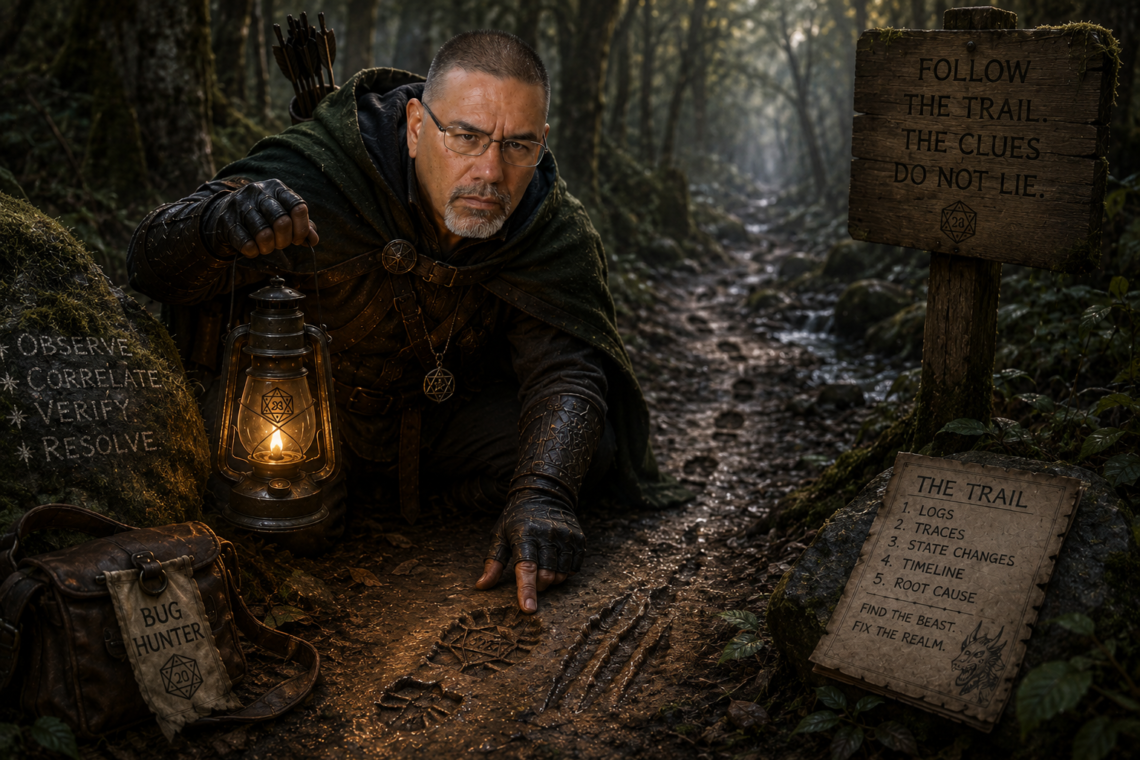
When a ranger hunts in the wilderness, the goal is never blind pursuit. No experienced tracker rushes into the woods swinging wildly at shadows. A seasoned hunter kneels beside the disturbed earth and studies what changed. Broken branches matter. Crushed grass matters. Mud displaced by unseen footsteps matters. Even silence matters because silence often means something passed through recently enough to frighten the birds from their songs. A hunter reads the world as evidence.
Software works the same way.
A bug changes the landscape around it. Logs shift. State mutates. Requests slow. Timing behaves strangely. Memory usage bends upward when it should settle. A service begins whispering warnings before finally collapsing into failure. None of these things happen without reason. Systems do not simply wake up one morning and decide chaos sounds entertaining. Something changed, and our task as bug hunters is learning to follow the trail back to its source.
The first lesson of this hunt begins with logs, though I must warn you that many developers misunderstand what logs are supposed to accomplish. Too often I encounter applications that treat logging like frantic notes scribbled by terrified villagers fleeing a dragon attack.
console.log("started");
console.log("running");
console.log("something broke");
console.log("done");
If this feels familiar, do not worry. Nearly every developer begins here. Yet consider what happens when disaster strikes at three in the morning and you are staring at thousands of lines of output while sleep deprivation gnaws at your patience like goblins stealing supplies from camp. What story does this tell you? Which user experienced the issue? What action triggered failure? Which step succeeded before disaster struck? What state existed at the time?
The answer, of course, is nothing useful.
That is not a trail.
That is someone wandering through the forest screaming into the darkness and hoping the beast politely announces its location.
A proper bug hunter marks the trail with intention. Good logging tells a story rich enough that another hunter could arrive later and reconstruct events without guessing. Let us imagine we are tracking a checkout bug where customers occasionally lose their carts moments before payment. At first glance, the issue feels random. Support reports inconsistency. Developers swear the code looks fine. Leadership begins wondering whether invisible curses plague the kingdom.
This is where evidence must replace fear.
app.post("/checkout", async (req, res) => {
  const userId = req.session.userId;
  const cartItems = req.body.items;

  console.log({
    event: "checkout_started",
    userId,
    itemCount: cartItems.length,
    timestamp: new Date().toISOString()
  });

  try {
    const order = await createOrder(cartItems);

    console.log({
      event: "order_created",
      userId,
      orderId: order.id,
      timestamp: new Date().toISOString()
    });

    const payment = await processPayment(order);

    console.log({
      event: "payment_completed",
      userId,
      paymentId: payment.id,
      timestamp: new Date().toISOString()
    });

    res.status(200).json(payment);

  } catch (error) {

    console.error({
      event: "checkout_failed",
      userId,
      message: error.message,
      stack: error.stack,
      timestamp: new Date().toISOString()
    });

    res.status(500).send("Checkout failed");
  }
});
Now we possess something valuable. We know who encountered the problem. We know when it happened. We know which stage completed successfully and which stage failed. More importantly, we possess sequence. A trail only becomes meaningful when events unfold in order. A ranger tracking footprints does not merely care that tracks exist. They care which direction the creature moved, when the soil was disturbed, and whether the prey doubled back upon itself.
That lesson becomes even more important once systems grow larger. Modern applications rarely fail in isolation. One request may pass through authentication services, APIs, databases, caches, queues, and third party systems before finally returning to the user. Somewhere along that journey, the creature strikes. The problem is that symptoms rarely appear where the attack actually happened.
Imagine a kingdom messenger tasked with carrying vital information between cities. Somewhere during the journey, the message disappears. Did bandits attack? Did the horse collapse? Did the messenger take shelter and never continue? Without tracking the route, nobody knows where the problem began.
Distributed systems feel exactly like this.
Consider an order workflow.
async function processOrder(orderId) {
  const order = await fetchOrder(orderId);

  const payment = await processPayment(order);

  const shipment = await reserveShipment(order);

  return {
    payment,
    shipment
  };
}
Everything appears simple until customers begin reporting missing shipments even though payment processed successfully. Panic spreads quickly because nobody knows where failure lives. Developers blame shipping. Shipping blames payment. Payment blames infrastructure. Infrastructure blames traffic volume like villagers blaming storms for every inconvenience.
This is why traces matter.
A hunter follows continuity.
We create correlation identifiers that follow requests across every stage of the journey.
const crypto = require("crypto");

async function processOrder(orderId) {
  const traceId = crypto.randomUUID();

  console.log({
    traceId,
    event: "order_started",
    orderId
  });

  const order = await fetchOrder(orderId);

  console.log({
    traceId,
    event: "payment_started"
  });

  const payment = await processPayment(order);

  console.log({
    traceId,
    event: "shipment_started"
  });

  const shipment = await reserveShipment(order);

  console.log({
    traceId,
    event: "order_completed"
  });

  return {
    payment,
    shipment
  };
}
Something subtle but powerful has changed here. Suddenly every clue belongs to the same story. Rather than combing through endless unrelated logs like an overwhelmed scholar drowning in scattered scrolls, I can follow one request from beginning to end. If payment succeeds but shipment never begins, I know exactly where the trail grows cold.
Still, the most dangerous prey often hides deeper than logs and traces.
State changes.
If I could teach only one habit to every apprentice bug hunter, it would be this: ask what changed.
Most failures do not arrive dramatically. They creep. Something small mutates quietly. Shared state leaks between requests. A cached value refuses to expire. A variable behaves correctly until the wrong conditions align. By the time symptoms appear, the cause may already be far behind us.
Consider this deceptively harmless example.
let discountRate = 0;

function applyDiscount(user) {
  if (user.isPremium) {
    discountRate = 0.20;
  }
}

function calculateTotal(price) {
  return price - (price * discountRate);
}
At first glance, the code feels innocent enough. Yet imagine a premium user logs in and receives a discount. Suddenly every customer after them receives the same discount whether they earned it or not. Chaos follows. Reports arrive inconsistently. Nobody can reproduce the issue reliably because the state changes depend upon timing and sequence.
This creature thrives because state remains invisible.
A hunter illuminates hidden movement.
function applyDiscount(user) {
  const discountRate = user.isPremium
    ? 0.20
    : 0;

  console.log({
    event: "discount_applied",
    userId: user.id,
    premiumStatus: user.isPremium,
    discountRate
  });

  return discountRate;
}

function calculateTotal(price, discountRate) {
  return price - (price * discountRate);
}
Now the system speaks clearly. State becomes observable instead of mysterious. Hidden magic disappears.
One habit I rely upon constantly during difficult hunts is building timelines. A timeline transforms chaos into narrative because bugs almost always reveal themselves through sequence if you gather enough evidence. When something fails, I ask three questions before anything else.
What happened?
What changed?
What happened immediately before the change?
Simple questions often reveal extraordinary answers. Imagine a production application crashing every few days with no obvious explanation. Monitoring reports occasional spikes in memory usage, but nobody notices a clear pattern. Restarts seem to help temporarily, yet the crashes return often enough to keep everyone nervous.
Impatient hunters fail here because they want immediate certainty.
The wilderness rarely offers such kindness.
Instead, I gather evidence over time.
setInterval(() => {
  const memory = process.memoryUsage();

  console.log({
    rss: memory.rss,
    heapUsed: memory.heapUsed,
    heapTotal: memory.heapTotal,
    uptime: process.uptime(),
    timestamp: new Date().toISOString()
  });
}, 30000);
Hours pass. Patterns emerge. Memory steadily rises but never meaningfully recovers. Garbage collection slows. CPU climbs. Eventually the application collapses beneath pressure that built quietly over time.
The creature reveals itself.
A memory leak.
Notice something important here. The crash itself was never the beginning of the story. It merely marked the final chapter. The real hunt started hours earlier, leaving clues for anyone patient enough to follow them.
Patience matters because software lies to us constantly. Symptoms disguise causes. Broken interfaces hide infrastructure failures. Network issues masquerade as frontend bugs. Databases quietly suffer while applications receive blame for crimes they did not commit. The bug hunter who survives longest learns restraint. Instead of assuming, they observe. Instead of guessing, they investigate.
This truth reminds me of old tales told around tavern hearths. Every doomed adventuring party contains someone reckless enough to charge ahead without understanding the danger. Perhaps it is the overconfident fighter sprinting into darkness or the wizard convinced every problem can be solved with more power. They mistake movement for progress.
The ranger survives.
The tracker survives.
The one who kneels beside disturbed earth and notices claw marks pointing east instead of west survives.
That is who we become during The Hunt.
We stop fearing complexity. We stop chasing shadows. We begin trusting evidence because evidence tells stories no assumption ever can. Logs become footprints. Traces become broken branches. State changes become disturbed earth beneath our boots.
Eventually, after enough hunts, something remarkable happens. You stop seeing logs as text scrolling endlessly across a terminal. You stop seeing traces as meaningless noise. You stop seeing strange timing issues as random inconvenience.
You begin reading them like maps.
And once you learn to read the map, the wilderness no longer feels endless. The darkness feels less oppressive. The creature grows less mysterious. Somewhere ahead, hidden just beyond the trees, the trail waits patiently for someone skilled enough to follow it.

Frank Jamison
Frank Jamison is a web developer and educator who writes about the intersection of structure, systems, and growth. With a background in mathematics, technical support, and software development, he approaches modern web architecture with discipline, analytical depth, and long term thinking. Frank served on active duty in the United States Army and continued his service with the California National Guard, the California Air National Guard, and the United States Air Force Reserve. His military career included honorable service recognized with the National Defense Service Medal. Those years shaped his commitment to mission focused execution, accountability, and calm problem solving under pressure. Through projects, technical writing, and long form series such as The CSS Codex, Frank explores how foundational principles shape scalable, maintainable systems. He treats front end development as an engineered discipline grounded in rules, patterns, and clarity rather than guesswork. A longtime STEM volunteer and mentor, he values precision, continuous learning, and practical application. Whether refining layouts, optimizing performance, or building portfolio tools, Frank approaches each challenge with the same mindset that guided his years in uniform: understand the system, respect the structure, and execute with purpose.


You May Also Like

The Bug Hunter’s Codex, Part X: The Killing Blow

The Bug Hunter’s Codex, Part V: Binding the Conditions