-
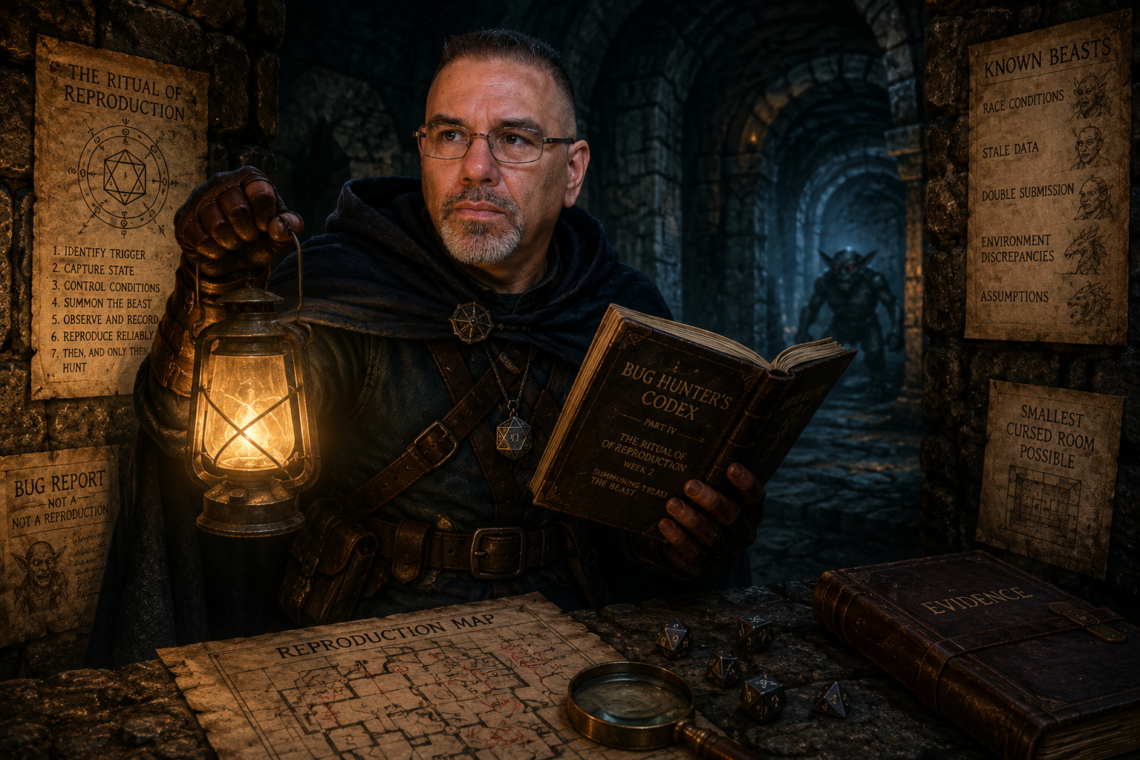
The Bug Hunter’s Codex, Part IV: The Ritual of Reproduction
No creature can be slain if it cannot be summoned. Control the conditions, or remain in the dark. When young developers first begin hunting bugs, they often believe the battle begins at the moment something breaks. A button fails, a form behaves strangely, an API returns nonsense, and immediately they reach for their weapons. They open files at random, scatter console logs across the codebase like breadcrumbs tossed into a storm, and begin changing conditions in hopes that luck will reveal the answer. I understand the instinct. When a creature has already wounded the village, urgency feels noble. Yet experience has taught me something far less dramatic and infinitely more…
-
One More Potion in the Pack: The Performance Cost of One Extra Image
There is a moment in every campaign when someone insists it is only one more item. One more rope. One more potion. One more mysterious glowing artifact that absolutely will not awaken something ancient. Then the party slows down. Movement decreases. Initiative suffers. The dragon closes the distance. I used to treat images that way in my projects. It is only one more image. It will enhance the design. It will elevate the aesthetic. What could it possibly cost. More than I expected. I learned this while refining one of my portfolio builds. The layout was clean. The typography was intentional. The JavaScript was efficient. Performance metrics were solid. Then…
-
Forms, Validation, and Trust: Guarding the Gates of the Digital Realm
When I build a form, I no longer see text inputs and buttons. I see the gates of a city. On one side stands a traveler. On the other side stands my application. Between them is a portcullis made of HTML, guarded by validation rules, warded by server logic, and lit by the flickering torches of user feedback. If I design it poorly, the traveler turns away. If I design it carelessly, something darker slips through. Forms are not paperwork. They are the social contract of the web. They are where trust is negotiated. And in my experience, trust is the most powerful magic in any system. The Gatehouse: Structure…