-
The Bug Hunter’s Codex, Part X: The Killing Blow
Strike at the source. Anything less is mercy, and mercy has consequences. There is a point in every hunt when the lantern is no longer enough. You have followed the tracks, read the claw marks, listened to the villagers describe the shape moving beyond the tree line, and mapped the dungeon room by room until the pattern finally reveals itself. At that moment, the hunter must stop circling the beast and decide where to strike. Debugging reaches that same point when investigation turns into correction, and the difference between a clean kill and a wounded monster is whether you understand the source deeply enough to end it. This week’s theme…
-
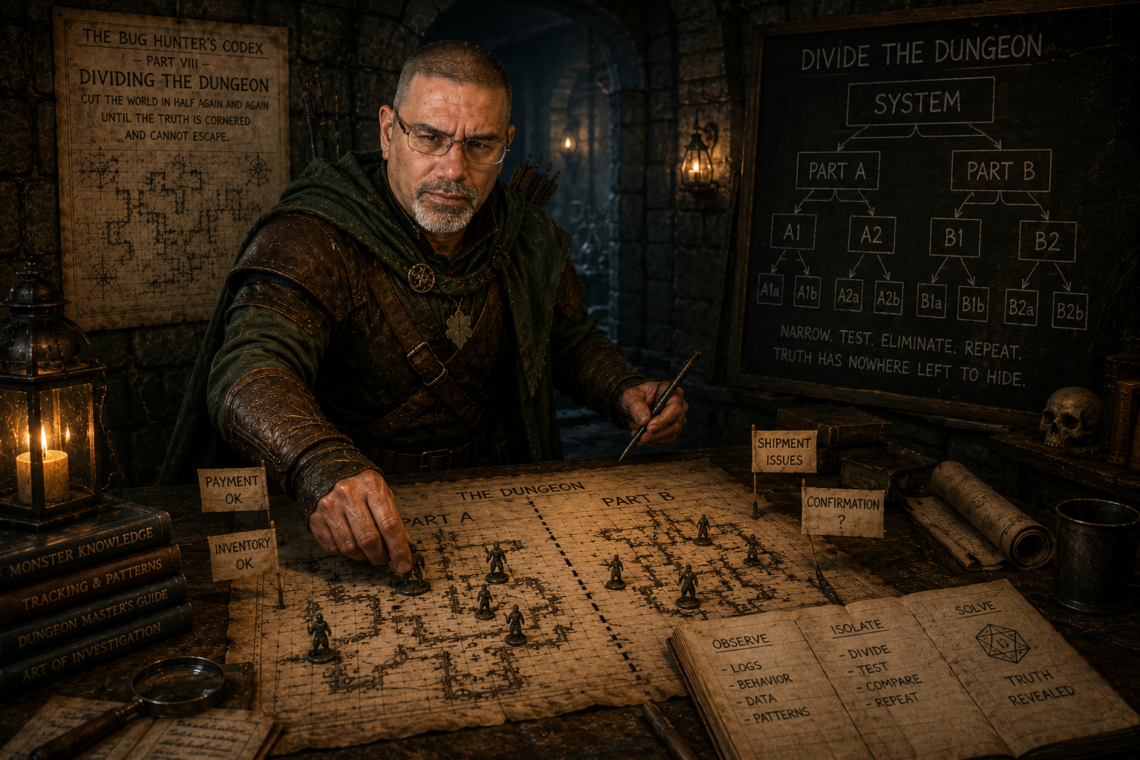
The Bug Hunter’s Codex, Part VIII: Dividing the Dungeon
Cut the world in half again and again until the truth is cornered and cannot escape. There comes a moment in every hunt where instinct alone stops being enough. Earlier in this journey, I spoke about strange behavior, misleading symptoms, corrupted logs, and elusive failures that seem to vanish the moment attention settles upon them. During those earlier lessons, instinct served us well because early hunting requires observation. We must first recognize that something unnatural walks among the ordinary. Yet eventually, every hunter encounters a problem that grows too large to comfortably understand. Systems intertwine. Dependencies overlap. Symptoms multiply. Logs contradict one another. Before long, even experienced developers begin to…
-
The Bug Hunter’s Codex, Part V: Binding the Conditions
Bugs are not born in isolation. They emerge when timing, state, and environment align. When an apprentice first joins me at the campfire after a long day of hunting, there is always a moment when confidence outruns wisdom. I see it in the way they speak about broken systems, as though every bug waits patiently in a single line of code, eager to confess its crimes under the slightest scrutiny. They imagine software failures as lone goblins wandering too close to civilization, isolated threats easily dispatched by a sharp eye and a sharper keyboard. Experience has taught me otherwise. The creatures worth fearing are rarely solitary, and the bugs that…