-
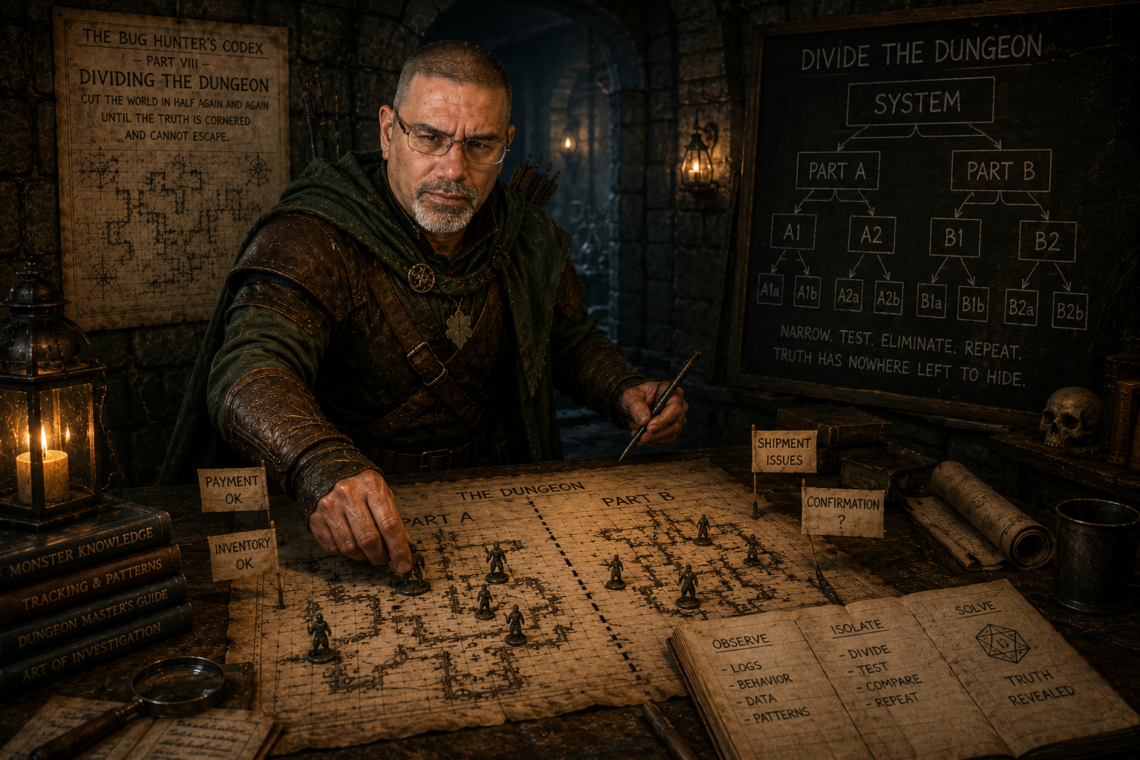
The Bug Hunter’s Codex, Part VIII: Dividing the Dungeon
Cut the world in half again and again until the truth is cornered and cannot escape. There comes a moment in every hunt where instinct alone stops being enough. Earlier in this journey, I spoke about strange behavior, misleading symptoms, corrupted logs, and elusive failures that seem to vanish the moment attention settles upon them. During those earlier lessons, instinct served us well because early hunting requires observation. We must first recognize that something unnatural walks among the ordinary. Yet eventually, every hunter encounters a problem that grows too large to comfortably understand. Systems intertwine. Dependencies overlap. Symptoms multiply. Logs contradict one another. Before long, even experienced developers begin to…
-
The Bug Hunter’s Codex, Part V: Binding the Conditions
Bugs are not born in isolation. They emerge when timing, state, and environment align. When an apprentice first joins me at the campfire after a long day of hunting, there is always a moment when confidence outruns wisdom. I see it in the way they speak about broken systems, as though every bug waits patiently in a single line of code, eager to confess its crimes under the slightest scrutiny. They imagine software failures as lone goblins wandering too close to civilization, isolated threats easily dispatched by a sharp eye and a sharper keyboard. Experience has taught me otherwise. The creatures worth fearing are rarely solitary, and the bugs that…
-
The Bug Hunter’s Codex, Part IV: The Ritual of Reproduction
No creature can be slain if it cannot be summoned. Control the conditions, or remain in the dark. When young developers first begin hunting bugs, they often believe the battle begins at the moment something breaks. A button fails, a form behaves strangely, an API returns nonsense, and immediately they reach for their weapons. They open files at random, scatter console logs across the codebase like breadcrumbs tossed into a storm, and begin changing conditions in hopes that luck will reveal the answer. I understand the instinct. When a creature has already wounded the village, urgency feels noble. Yet experience has taught me something far less dramatic and infinitely more…