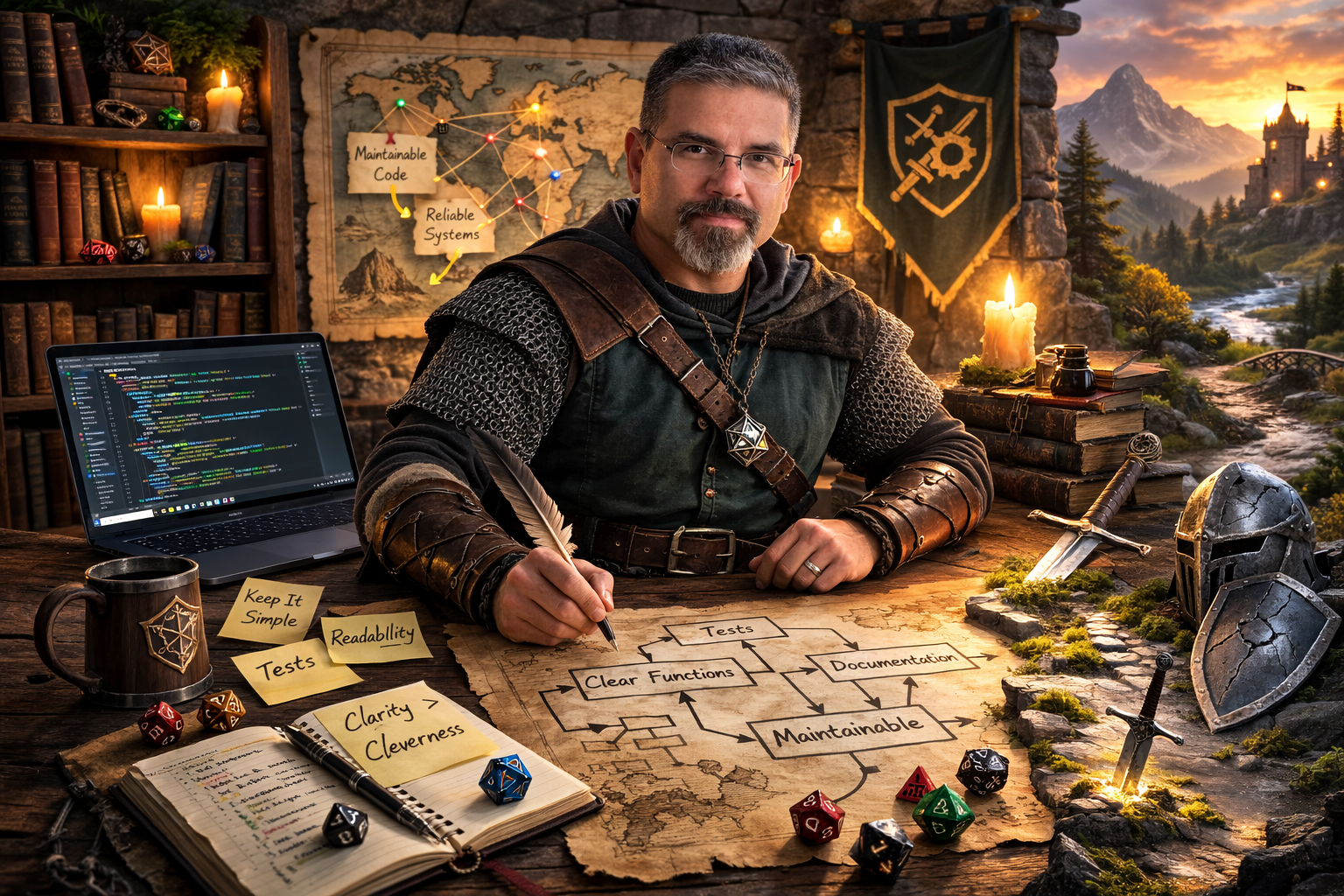
If you have ever played a long running Dungeons and Dragons campaign, you know that the party rarely falls apart because the fighter showed up in plain armor and swung a dependable sword. The chaos usually starts when someone insists on building a wild multiclass sorcerer bard warlock experiment that only works under a full moon during initiative order. I have learned that software development works the same way. The code that saves projects is rarely flashy. It is steady, readable, predictable. It is, in the best possible way, boring. Early in my development journey, I chased cleverness. I wanted elegant one liners, intricate abstractions, and patterns that made other…
-
-
There is a moment in every campaign when someone insists it is only one more item. One more rope. One more potion. One more mysterious glowing artifact that absolutely will not awaken something ancient. Then the party slows down. Movement decreases. Initiative suffers. The dragon closes the distance. I used to treat images that way in my projects. It is only one more image. It will enhance the design. It will elevate the aesthetic. What could it possibly cost. More than I expected. I learned this while refining one of my portfolio builds. The layout was clean. The typography was intentional. The JavaScript was efficient. Performance metrics were solid. Then…
-
When I build a form, I no longer see text inputs and buttons. I see the gates of a city. On one side stands a traveler. On the other side stands my application. Between them is a portcullis made of HTML, guarded by validation rules, warded by server logic, and lit by the flickering torches of user feedback. If I design it poorly, the traveler turns away. If I design it carelessly, something darker slips through. Forms are not paperwork. They are the social contract of the web. They are where trust is negotiated. And in my experience, trust is the most powerful magic in any system. The Gatehouse: Structure…
-
When I started teaching, I thought my job was to know the material. Know it cold. Know it forward and backward. Be ready for every question. What I learned instead is that knowing something and explaining something are two very different skills. That realization followed me back into software development. In the classroom, I could solve a problem in my head in seconds. But when I tried to explain it the same way I solved it – jumping steps, skipping assumptions, compressing logic – I would lose half the room. The students weren’t confused because the material was impossible. They were confused because I had teleported from A to D…
-
I used to think that if my JavaScript ran without errors, I had done my job. If the feature shipped, the console stayed quiet, and the tests passed, I’d mentally roll for loot and move on. Victory secured. XP gained. On to the next quest. But somewhere between shipping features and revisiting old projects, I started noticing something uncomfortable: working code is not the same thing as readable code. And readable code is the difference between a clean campaign journal and a pile of crumpled notes written during combat. One of the first times this hit me was with a small function that filtered active users and displayed their names…
-
There was a time when I treated layout like it started at display: flex;. If something wasn’t aligned, spaced, or distributed exactly the way I imagined, I didn’t pause to understand what the browser was already doing. I just reached for Flexbox. It felt like leveling up. Normal document flow, on the other hand, felt like the starter dungeon. Functional. Necessary. But not where the “real” mechanics lived. That assumption was wrong. Because CSS flow isn’t the tutorial. It’s the physics engine. Flexbox is a powerful positioning spell layered on top of it. And if you don’t understand the world’s physics, you end up burning high-level slots to solve low-level…
-
For a long time, I treated learning like an endless dungeon crawl. No rests. No pauses. Just door after door, room after room, always pushing forward. If something was labeled advanced, I assumed that’s where I should be heading next. Anything else felt like backtracking – or worse, like I was wasting time. So I skipped ahead. Advanced JavaScript. Advanced frameworks. Advanced patterns. If the topic sounded difficult, prestigious, or slightly intimidating, I convinced myself it was necessary. That’s where real developers lived, right? High-level characters throwing fireballs while I pretended I wasn’t still squinting at the rules. I wasn’t learning badly. I was learning exhausted. And like any party…
-
I thought it was CSS.Of course I did. When a layout breaks, CSS is the usual suspect—the rogue with its hood up, pretending it didn’t touch anything. Margins collapse, flex items misbehave, something refuses to center even though you swear it’s centered. We’ve all been there, tightening selectors and muttering !important like a forbidden incantation. This time, the UI looked wrong in a way that felt familiar. A component was shifting unexpectedly. Spacing felt off. Elements that should have been aligned were… not. The kind of visual wrongness that whispers, “Your box model is haunted.” So I did what any seasoned adventurer does at the start of a dungeon: I…
-
I didn’t fall in love with HTML.I tolerated it. Like a lot of developers, I treated HTML as the tutorial zone. The place you pass through on your way to the real game – JavaScript, frameworks, flashy interactions, dragons that breathe async fire. HTML felt like the character sheet you fill out quickly so you can start rolling initiative. That was a mistake. Over time – through teaching, debugging, accessibility audits, and rebuilding things I swore I’d never rebuild – I realized something quietly profound: HTML isn’t just structure. It’s a contract. A contract between you and the browser.Between your code and assistive technologies.Between your present self and future-you at…
-
Every party needs one. Not the flashiest character. Not the one critting for 80 damage every round. The one who quietly keeps everyone alive, patches mistakes, and somehow makes the whole dungeon run smoother without demanding attention. In front-end development, that character is Bootstrap. Bootstrap isn’t trendy. It doesn’t promise enlightenment or rewrite the rules of the universe. It just… works. And in a profession where half your bugs come from things not behaving the way you expected, that’s a superpower. This article is for developers who already know HTML and CSS, maybe dabble in JavaScript, and want to understand what Bootstrap actually gives you, why it still matters, and…